


Address:South of 18th Floor, New Oriental International Technology Center, 567 Jiangling Road, Binjiang District, Hangzhou City
New product development
Heat exchangers are indispensable pieces of equipment in industrial facilities. For many years, developed countries around the world have invested significant human and material resources in researching and developing heat exchangers that are highly efficient and compact in design. Currently, our company has developed coil-type heat exchangers in a variety of structural configurations. Due to their compact design, small footprint, and high heat transfer efficiency, as well as their ability to withstand high pressure, handle multi-stream heat exchange, and provide excellent thermal compensation, these heat exchangers have become the preferred critical process equipment in industries such as new energy, smelting, and petrochemicals—particularly in large-scale chemical and new energy facilities.
I. Structural Design and Technical Specifications of Wound Tube Heat Exchanger (Using the first domestically produced high-pressure Wound Tube Heat Exchanger at a certain chemical plant as an example)
1. Design Calculation Basis: This Wound Tube Heat Exchanger is a two-stream methanol/methanol heat exchanger with boiling phase change occurring in the shell side. To meet the requirement of a 10% increase in plant production, corresponding adjustments were made to the design parameters during heat load calculations. The shell-side flow rates were increased by 10% for the calculations, while maintaining the original design inlet and outlet temperatures and pressures. When selecting the fouling thermal resistance value, the value originally recommended by a certain company was too low. However, after actual operation, severe corrosion and fouling in the heat exchanger led to a decline in heat transfer performance. In light of this, and in conjunction with the evaluation results of the hot-state grid-connection tests for the coil-type heat exchanger test unit at Zhenhai Refining & Chemical Company’s Fertilizer Plant, a higher fouling thermal resistance value was adopted during selection to enhance equipment safety.
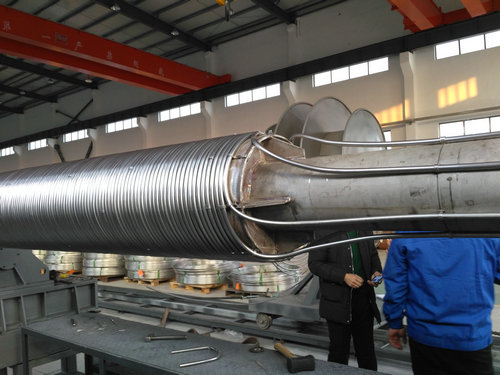
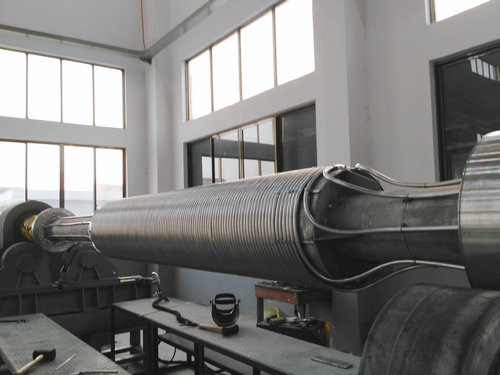
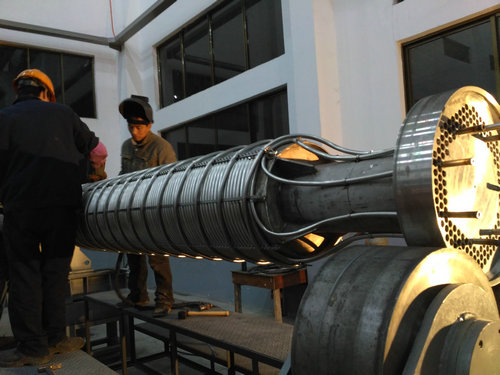
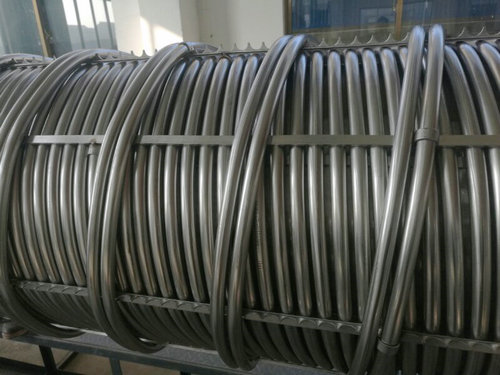
2. Structural Design Features: The coil-type heat exchanger consists of two parts: the coil core and the shell. The coil core comprises a central cylinder, heat exchange tubes, spacers, and tube clamps. The heat exchange tubes are tightly wound around the central cylinder and separated by flat and shaped spacers to ensure proper lateral and longitudinal spacing between the tubes. The spacers are fixed to the tubes using tube clamps, while the heat exchange tubes are connected to the tube sheet via high-strength welds. The central cylinder serves as a support during manufacturing and therefore requires a certain level of strength and rigidity. The shell consists of a cylindrical body and end caps.
For many years, our company has collaborated with industry experts who are graduates of Xi’an Jiaotong University. Through years of design, manufacturing, processing, and practical application, the spiral-wound heat exchanger developed by our company features the following characteristics:
a) High heat transfer coefficient and efficiency, with a minimum end-to-end temperature difference of 2°C;
b) Compact structure with a large heat transfer area per unit volume. For heat transfer tubes with diameters of 8–20 mm, the heat transfer area per cubic meter of volume can reach 100–170 m². A single spiral-wound heat exchanger of the same volume can replace several shell-and-tube heat exchangers;
c) Capable of simultaneous heat transfer between multiple media;
d) High operating pressure inside the tubes, with a maximum operating pressure of up to 25.0 MPa;
e) Good thermal compensation capability, as thermal expansion of the heat transfer tubes can be partially self-compensated;
f) Easily scalable to large sizes; the current maximum heat transfer area has reached 25,000 m²;
g) Low system resistance, excellent heat transfer performance, and thorough recovery of cooling capacity, thereby reducing system energy consumption.
II. Application Areas of Wound Tube Heat Exchanger:
1. Future Outlook: Wound Tube Heat Exchanger are currently widely used in the coal chemical industry, such as in large-scale internal compression air separation units, methanol plants, and natural gas liquefaction and recovery facilities. As research into Wound Tube Heat Exchanger deepens, initial successes have been achieved in expanding their application areas, with the following trends emerging:
a) Larger-scale Wound Tube Heat Exchanger
Due to their unique structure—featuring small heads and tubes that can extend up to hundreds of meters in length—several large-scale spiral-wound heat exchangers have already been developed. For example, a large spiral-wound heat exchanger manufactured by our company measures Φ2040 mm × 17,000 mm, weighs 71 tons, and has a heat transfer area of 3,700 m², which is approximately three times that of a conventional shell-and-tube heat exchanger of similar design. As industrial facilities continue to grow in scale, there is a corresponding demand for increasingly larger spiral tube heat exchangers, with weights exceeding 100 tons. In contrast, conventional shell-and-tube heat exchangers cannot be scaled up further due to limitations imposed by the tube length.
b) Self-Compensation of Thermal Expansion in Spiral Tube Heat Exchangers
Spiral tube heat exchangers offer highly efficient heat transfer performance and are currently primarily used in cryogenic applications. However, provided the medium permits, we can fully leverage the thermal compensation advantages of spiral tube heat exchangers in high-temperature operating environments.
c) High-Pressure Capabilities of Coiled-Tube Heat Exchangers
Coiled-tube heat exchangers are currently used primarily in applications with high tube-side pressure and low shell-side pressure; typically, tube-side pressure can reach 25.0 MPa, while shell-side pressure is generally less than 5.0 MPa. Due to the design characteristics of coiled-tube heat exchangers—small tube sheets, large shell-side diameters, and small inlet heads at both ends—this structure overcomes the drawbacks of conventional high-pressure heat exchangers. Conventional medium- and high-pressure shell-and-tube heat exchangers typically employ floating-head or U-tube designs. At higher pressures, not only does the shell (tube sheet) thickness increase, but the strength grade of the flanges must also be significantly raised. This results in extremely large shell-and-tube heat exchangers with very thick flanges, and it also poses significant sealing challenges. Furthermore, as plant facilities grow in scale, high-pressure heat exchangers must also be scaled up, which complicates manufacturing. In contrast, spiral tube heat exchangers can increase their surface area by extending their length, and the tube sheets at both ends use smaller connecting flanges, making them easier to manufacture.
d) Wound Tube Heat Exchanger can be fabricated into multi-stream fluidized heat exchange equipment.
e) As their application matures, Wound Tube Heat Exchanger have gradually achieved multi-stream heat exchange—a unique capability unmatched by other shell-and-tube heat exchangers. A single heat exchanger with one shell-side medium can simultaneously exchange heat with two or three tube-side media, thereby significantly improving the plant’s heat transfer efficiency and heat exchange capacity while reducing the number of heat exchangers required.
Due to their highly efficient heat transfer performance, Wound Tube Heat Exchanger are evolving not only toward larger-scale designs but also toward miniaturization. In spaces where conventional heat exchangers cannot meet performance requirements, Wound Tube Heat Exchanger can satisfy these demands within the same space. It is precisely because of these excellent performance characteristics that Wound Tube Heat Exchanger have found applications in the micro-scale field.
As China gains a deeper understanding of the design and manufacturing processes for high-pressure Wound Tube Heat Exchanger, and given their unique advantages that cannot be replicated by other types of heat exchangers, their scope of application will continue to expand.
The coil heat exchangers designed, produced, and manufactured by our company have been developed and deployed in various fields, including chemical processing, carbon dioxide systems, cryogenic applications, and new energy storage. The longest operational lifespan of these units has exceeded eight years. Because our coil heat exchangers are designed with meticulous consideration, manufactured with precision, and utilize specialized welding techniques, we can ensure long-term stable operation and consistent product quality.
Contact Us
Address:South of 18th Floor, New Oriental International Technology Center, 567 Jiangling Road, Binjiang District, Hangzhou City

Phone:+86-571-87177512 87177550 87177513

Email:hangzhoukuaikai@vip.163.com

Fax:0571-87177570
Quick Navigation

Browse the mobile website